

Advancing the Dimensions of Endosonography Through a Strategic MedTech Partnership
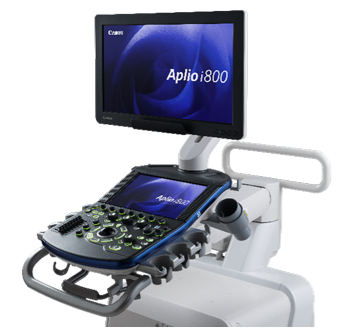
The Aplio i800 EUS premium ultrasound system is now available to Olympus EUS customers in the U.S. via a strategic partnership between Olympus and Canon Inc. This leading-edge technology offers powerful imaging that provides deep penetration and high resolution and offers advanced, clinically validated tools that allow for a wide range of clinical applications.
CENTER VALLEY, Pa. and TUSTIN, Calif. (April 6, 2026) – Olympus Corporation of the Americas (Olympus) and Canon Medical Systems USA, Inc. today announced another milestone in their strategic partnership with the U.S. launch of the Aplio i800 EUS premium ultrasound system (Aplio i800 EUS system). Manufactured by Canon Inc. and distributed exclusively by Olympus, the Aplio i800 EUS system joins Olympus’ comprehensive portfolio of echoendoscopes and endotherapy devices to support high-quality imaging and confident clinical assessment in a wide range of endoscopic ultrasound (EUS) procedures.
The Aplio i800 EUS system provides innovative imaging technology to support diagnosis of hepato-pancreato-biliary conditions, including liver and pancreatic diseases. Diagnosing these conditions through imaging is particularly challenging due to complex anatomical locations, the need for high-resolution imaging to detect early-stage abnormalities, and the need to differentiate between potentially malignant and benign lesions.
“We are thrilled to bring this state-of-the-art diagnostic technology to clinicians in the U.S.,” said Patrick Romano, Regional Business Unit Lead and Vice President for Gastrointestinal Solutions at Olympus Corporation of the Americas. “The Aplio i800 EUS system elevates the capabilities of our ultrasound portfolio to support clinicians in achieving more efficient workflows and more confident diagnoses within the complex HPB anatomy. Our strategic partnership with Canon, Inc. reflects a continued focus on innovation designed to meet evolving clinical needs and expand the possibilities of endoscopy-enabled care.”
“Diagnostic imaging has always been at the heart of our business, inspired by our Made for Life philosophy and our mission to support medical care that protects every life. Our long history in diagnostic ultrasound has led to breakthrough technologies that help clinicians confidently assess disease early in its progression,” said John Serovich, Vice President of the Ultrasound/X-ray Business Unit at Canon Medical Systems USA, Inc. “Partnering with Olympus, one of the world’s foremost endoscope manufacturers, marks an exciting step forward as we work together to elevate the future of EUS.”
A Multipurpose EUS Ultrasound Platform Supporting Clinician Confidence
The Aplio i800 EUS system supports efficient operation in the procedure room through an adaptable design that allows clinicians to tailor the system to their procedural needs. Offering an abundance of advanced, clinically validated tools, the Aplio i800 EUS system accommodates diverse EUS workflows and user preferences.
The Aplio i800 EUS system’s innovative imaging technology provides clarity, depth, and detail to support confident diagnoses and interventions across liver, pancreatic, and gastrointestinal procedures. These include1:
- Differential Tissue Harmonic Imaging (D-THI) expands the effective bandwidth to simultaneously achieve increased penetration and high resolution with sensitivity in both superficial and deep regions compared to other THI methods
- Quick Scan allows automatic gain adjustment for uniform imaging with one click
- Full Focus technology supports clear, uniform imaging from near to far field without manual focus adjustments
Advanced Liver and Pancreatic Assessment Tools
Liver and pancreatic diseases are among the gastrointestinal diseases and disorders representing a significant healthcare challenge worldwide.2 As these diseases often progress silently until they reach advanced stages when treatment options are limited and outcomes are poor, early diagnosis is critical to enabling timely clinical decision making, improving care planning, and reducing the burden on patients, caregivers, and healthcare systems.3,4 By supporting detection and diagnosis, advanced technologies such as EUS have the potential to help clinicians intervene early, guide appropriate therapy, and support efficient use of healthcare resources.5
“Liver disease spans a wide and complex range of pathologies, demanding imaging solutions that deliver clarity, consistency, and clinical confidence,” said Marvin Ryou, MD, Director of Endoscopic Innovation and Associate Professor of Medicine at Harvard Medical School. “The Aplio i800 EUS system advances endoscopic liver assessment with its next-generation quantitative technologies — Shear Wave Elastography and Attenuation Imaging. These quantitative tools enhance endoscopic assessment of hepatic stiffness and tissue composition, supporting characterization and a streamlined, endohepatology-driven diagnostic workflow.”
For liver disease assessment, the Aplio i800 EUS system includes imaging tools designed to support assessment and reporting across a wide range of liver pathologies. These includei1:
- Attenuation Imaging (ATI), which supports the assessment of steatosis through quantification of the attenuation coefficient
- Shear Wave Elastography (SWE), a non invasive technology that provides quantitative measures and dynamic displays of tissue stiffness
- Contrast Harmonic Imaging (CHI), used with ultrasound contrast agents to support characterization of focal liver lesions
- Multi Parametric Reporting, designed to combine results from SWE, ATI, and external exams into a single report
For pancreatic evaluations, the system offers high resolution imaging and tools designed to support confident assessment, including1:
- Superb Micro-vascular Imaging (SMI), designed to reveal low velocity, microvascular blood flow with reduced motion artifacts
- Smart 3D, enabling acquisition and reconstruction of 3D image data using cine memory images
- Panoramic View, designed to create a single, wide-view image to allow for visualization of anatomy larger than the normal scanning field of view of the transducer
- Strain Elastography, which provides a visual representation of tissue elasticity to support tissue assessment
Physicians interested in a live demonstration of the Aplio i800 EUS system are welcome to visit the Olympus Booth #4611 at the 2026 Digestive Disease Week in Chicago, May 3-5. Information about clinicians who will be offering their insights into use of the Aplio i800 EUS system at DDW will also be available at the Olympus booth.
Visit the Aplio i800 EUS system webpage to learn more.
EUS Procedure Risks
Potential complications that may be associated with endoscopic ultrasound include, but are not limited to, the following: sore throat, infection, bleeding, perforation, and/or tumor seeding (when EUS-FNA or FNB is performed). Do not use contrast agents when using the shear wave function. Do not use the shear wave function during puncturing or the interposition of any other type of metal. Contrast imaging and shear wave elastography functions are for GI only.
Disclaimer: The features and functionality described are available with the Aplio i800 EUS system. Please refer to the Instructions for Use for echoendoscope compatibility.
# # #
About Olympus Corporation of the Americas
At Olympus, we are committed to Our Purpose of making people’s lives healthier, safer and more fulfilling. As a global medical technology company, we partner with healthcare professionals to provide innovative solutions and services for early detection, diagnosis and minimally invasive treatment, aiming to improve patient outcomes by elevating the standard of care in targeted disease states.
For more than 100 years, Olympus has pursued a goal of contributing to society by producing products designed with the purpose of delivering optimal outcomes for its customers around the world.
Olympus Corporation of the Americas, a wholly owned subsidiary of Olympus Corporation, is headquartered in Center Valley, Pennsylvania, USA, and employs more than 4,500 employees throughout locations in North and South America. For more information, visit www.olympusamerica.com.
About Canon Medical Systems USA, Inc.
Canon Medical provides a comprehensive range of medical imaging solutions, including CT, diagnostic and interventional X-ray, MRI, ultrasound, service solutions, and advanced Healthcare IT. Guided by our Made for Life philosophy, patients are at the heart of everything we do. Our mission is to equip healthcare professionals with innovative solutions that enhance clinical performance, safety, comfort, and outcomes—helping deliver better health opportunities for patients worldwide.
We invest in research and product development that directly addresses the real clinical, operational, and business needs of our customers. By improving accessibility, enabling cross-platform integration, and supporting patient-centered care pathways, we aim to deliver solutions that are both meaningful and impactful.
Working hand in hand with our medical, academic, and research partners, we build relationships founded on transparency, trust, and respect. Together, we strive to create industry-leading innovations that improve patient outcomes and enrich quality of life for communities around the world.
1 Data on File with Canon Medical Systems Corporation
2 Peery AF, Murphy CC, Anderson C, et al. Burden and Cost of Gastrointestinal, Liver, and Pancreatic Diseases in the United States: Update 2024. Gastroenterology. 2025 May;168(5):1000-1024. doi: 10.1053/j.gastro.2024.12.029.
3 Mack S, Koessler T, Bichard P., Frossard J. Pancreatic cancer: Epidemiology, risk factors, and prevention. Onco. 2025;5(3):37. doi:10.3390/onco5030037
4 Younossi, ZM, Wong G, Anstee QM, Henry L. The Global Burden of Liver Disease. Clin. Gastroenterol. Hepatol. 2023;21(8):1978-1991. doi:10.1016/j.cgh.2023.04.015.
5 Konikoff, T., Majumder, S. Early Detection of Pancreatic Cancer: Recent Advancements. Curr Treat Options Gastro 23. 2025;16. https://doi.org/10.1007/s11938-025-00480-w